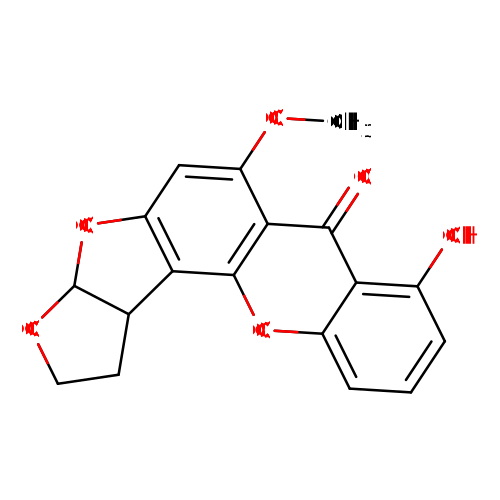
| Record Information |
|---|
| Version | 5.0 |
|---|
| Status | Expected but not Quantified |
|---|
| Creation Date | 2012-09-11 17:37:49 UTC |
|---|
| Update Date | 2022-03-07 02:52:36 UTC |
|---|
| HMDB ID | HMDB0030590 |
|---|
| Secondary Accession Numbers | |
|---|
| Metabolite Identification |
|---|
| Common Name | Dihydrosterigmatocystin |
|---|
| Description | Dihydrosterigmatocystin belongs to the class of organic compounds known as sterigmatocystins. These are a group of closely related fungal metabolites chemically characterized by a xanthone moiety fused to a dihydrodifurano or a tetrahydrodifurano moiety. The chemical difference among the various sterigmagocystins are the presence or absence of unsaturation at positions 2 and 3 of the difurano ring system, the substitution pattern on positions 6, 7, and 10 of the xanthone system and/or the substituent on position 3 of the difurano system. They are produced by Aspergilus spp. and Bipolaris spp. Based on a literature review a significant number of articles have been published on Dihydrosterigmatocystin. |
|---|
| Structure | COC1=CC2=C(C3CCOC3O2)C2=C1C(=O)C1=C(O)C=CC=C1O2 InChI=1S/C18H14O6/c1-21-11-7-12-13(8-5-6-22-18(8)24-12)17-15(11)16(20)14-9(19)3-2-4-10(14)23-17/h2-4,7-8,18-19H,5-6H2,1H3 |
|---|
| Synonyms | | Value | Source |
|---|
| 1,2-Dihydro-6-methoxy-7-hydroxyfuroxanthone | HMDB | | 5-Hydroxydihydrosterigmatocystin | HMDB |
|
|---|
| Chemical Formula | C18H14O6 |
|---|
| Average Molecular Weight | 326.3002 |
|---|
| Monoisotopic Molecular Weight | 326.07903818 |
|---|
| IUPAC Name | 15-hydroxy-11-methoxy-6,8,20-trioxapentacyclo[10.8.0.0²,⁹.0³,⁷.0¹⁴,¹⁹]icosa-1(12),2(9),10,14,16,18-hexaen-13-one |
|---|
| Traditional Name | 15-hydroxy-11-methoxy-6,8,20-trioxapentacyclo[10.8.0.0²,⁹.0³,⁷.0¹⁴,¹⁹]icosa-1(12),2(9),10,14,16,18-hexaen-13-one |
|---|
| CAS Registry Number | 6795-16-0 |
|---|
| SMILES | COC1=CC2=C(C3CCOC3O2)C2=C1C(=O)C1=C(O)C=CC=C1O2 |
|---|
| InChI Identifier | InChI=1S/C18H14O6/c1-21-11-7-12-13(8-5-6-22-18(8)24-12)17-15(11)16(20)14-9(19)3-2-4-10(14)23-17/h2-4,7-8,18-19H,5-6H2,1H3 |
|---|
| InChI Key | RHGQIWVTIHZRLI-UHFFFAOYSA-N |
|---|
| Chemical Taxonomy |
|---|
| Description | Belongs to the class of organic compounds known as sterigmatocystins. These are a group of closely related fungal metabolites chemically characterized by a xanthone moiety fused to a dihydrodifurano or a tetrahydrodifurano moiety. The chemical difference among the various sterigmagocystins are the presence or absence of unsaturation at positions 2 and 3 of the difurano ring system, the substitution pattern on positions 6, 7, and 10 of the xanthone system and/or the substituent on position 3 of the difurano system. They are produced by Aspergilus spp. And Bipolaris spp. |
|---|
| Kingdom | Organic compounds |
|---|
| Super Class | Phenylpropanoids and polyketides |
|---|
| Class | Sterigmatocystins |
|---|
| Sub Class | Not Available |
|---|
| Direct Parent | Sterigmatocystins |
|---|
| Alternative Parents | |
|---|
| Substituents | - Sterigmatocystin backbone
- Xanthone
- Dibenzopyran
- Xanthene
- Chromone
- Benzopyran
- 1-benzopyran
- Coumaran
- Anisole
- 1-hydroxy-4-unsubstituted benzenoid
- 1-hydroxy-2-unsubstituted benzenoid
- Alkyl aryl ether
- Pyranone
- Pyran
- Benzenoid
- Heteroaromatic compound
- Vinylogous ester
- Vinylogous acid
- Tetrahydrofuran
- Ether
- Oxacycle
- Acetal
- Organoheterocyclic compound
- Organooxygen compound
- Hydrocarbon derivative
- Organic oxygen compound
- Organic oxide
- Aromatic heteropolycyclic compound
|
|---|
| Molecular Framework | Aromatic heteropolycyclic compounds |
|---|
| External Descriptors | |
|---|
| Ontology |
|---|
| Physiological effect | Not Available |
|---|
| Disposition | |
|---|
| Process | Not Available |
|---|
| Role | Not Available |
|---|
| Physical Properties |
|---|
| State | Solid |
|---|
| Experimental Molecular Properties | | Property | Value | Reference |
|---|
| Melting Point | 230 °C | Not Available | | Boiling Point | Not Available | Not Available | | Water Solubility | Not Available | Not Available | | LogP | Not Available | Not Available |
|
|---|
| Experimental Chromatographic Properties | Not Available |
|---|
| Predicted Molecular Properties | |
|---|
| Predicted Chromatographic Properties | Predicted Collision Cross SectionsPredicted Retention Times Underivatized| Chromatographic Method | Retention Time | Reference |
|---|
| Measured using a Waters Acquity ultraperformance liquid chromatography (UPLC) ethylene-bridged hybrid (BEH) C18 column (100 mm × 2.1 mm; 1.7 μmparticle diameter). Predicted by Afia on May 17, 2022. Predicted by Afia on May 17, 2022. | 7.21 minutes | 32390414 | | Predicted by Siyang on May 30, 2022 | 13.9563 minutes | 33406817 | | Predicted by Siyang using ReTip algorithm on June 8, 2022 | 1.58 minutes | 32390414 | | Fem_Long = Waters ACQUITY UPLC HSS T3 C18 with Water:MeOH and 0.1% Formic Acid | 2482.9 seconds | 40023050 | | Fem_Lipids = Ascentis Express C18 with (60:40 water:ACN):(90:10 IPA:ACN) and 10mM NH4COOH + 0.1% Formic Acid | 358.7 seconds | 40023050 | | Life_Old = Waters ACQUITY UPLC BEH C18 with Water:(20:80 acetone:ACN) and 0.1% Formic Acid | 183.6 seconds | 40023050 | | Life_New = RP Waters ACQUITY UPLC HSS T3 C18 with Water:(30:70 MeOH:ACN) and 0.1% Formic Acid | 201.2 seconds | 40023050 | | RIKEN = Waters ACQUITY UPLC BEH C18 with Water:ACN and 0.1% Formic Acid | 252.1 seconds | 40023050 | | Eawag_XBridgeC18 = XBridge C18 3.5u 2.1x50 mm with Water:MeOH and 0.1% Formic Acid | 530.6 seconds | 40023050 | | BfG_NTS_RP1 =Agilent Zorbax Eclipse Plus C18 (2.1 mm x 150 mm, 3.5 um) with Water:ACN and 0.1% Formic Acid | 665.3 seconds | 40023050 | | HILIC_BDD_2 = Merck SeQuant ZIC-HILIC with ACN(0.1% formic acid):water(16 mM ammonium formate) | 119.6 seconds | 40023050 | | UniToyama_Atlantis = RP Waters Atlantis T3 (2.1 x 150 mm, 5 um) with ACN:Water and 0.1% Formic Acid | 1260.9 seconds | 40023050 | | BDD_C18 = Hypersil Gold 1.9µm C18 with Water:ACN and 0.1% Formic Acid | 458.0 seconds | 40023050 | | UFZ_Phenomenex = Kinetex Core-Shell C18 2.6 um, 3.0 x 100 mm, Phenomenex with Water:MeOH and 0.1% Formic Acid | 1502.7 seconds | 40023050 | | SNU_RIKEN_POS = Waters ACQUITY UPLC BEH C18 with Water:ACN and 0.1% Formic Acid | 403.7 seconds | 40023050 | | RPMMFDA = Waters ACQUITY UPLC BEH C18 with Water:ACN and 0.1% Formic Acid | 384.9 seconds | 40023050 | | MTBLS87 = Merck SeQuant ZIC-pHILIC column with ACN:Water and :ammonium carbonate | 355.1 seconds | 40023050 | | KI_GIAR_zic_HILIC_pH2_7 = Merck SeQuant ZIC-HILIC with ACN:Water and 0.1% FA | 302.5 seconds | 40023050 | | Meister zic-pHILIC pH9.3 = Merck SeQuant ZIC-pHILIC column with ACN:Water 5mM NH4Ac pH9.3 and 5mM ammonium acetate in water | 65.2 seconds | 40023050 |
Predicted Kovats Retention IndicesUnderivatizedDerivatized |
|---|
| GC-MS Spectra| Spectrum Type | Description | Splash Key | Deposition Date | Source | View |
|---|
| Predicted GC-MS | Predicted GC-MS Spectrum - Dihydrosterigmatocystin GC-MS (Non-derivatized) - 70eV, Positive | splash10-000t-1191000000-3169260a64a28510a099 | 2017-09-01 | Wishart Lab | View Spectrum | | Predicted GC-MS | Predicted GC-MS Spectrum - Dihydrosterigmatocystin GC-MS (1 TMS) - 70eV, Positive | splash10-0v5i-2019000000-18bb22e5571b45faf21c | 2017-10-06 | Wishart Lab | View Spectrum | | Predicted GC-MS | Predicted GC-MS Spectrum - Dihydrosterigmatocystin GC-MS (Non-derivatized) - 70eV, Positive | Not Available | 2021-10-12 | Wishart Lab | View Spectrum | | Predicted GC-MS | Predicted GC-MS Spectrum - Dihydrosterigmatocystin GC-MS (Non-derivatized) - 70eV, Positive | Not Available | 2021-10-12 | Wishart Lab | View Spectrum |
MS/MS Spectra| Spectrum Type | Description | Splash Key | Deposition Date | Source | View |
|---|
| Predicted LC-MS/MS | Predicted LC-MS/MS Spectrum - Dihydrosterigmatocystin 10V, Positive-QTOF | splash10-004i-0019000000-26331fd365b17b31be60 | 2015-04-24 | Wishart Lab | View Spectrum | | Predicted LC-MS/MS | Predicted LC-MS/MS Spectrum - Dihydrosterigmatocystin 20V, Positive-QTOF | splash10-004i-0049000000-ce5d50d5caadee2491e4 | 2015-04-24 | Wishart Lab | View Spectrum | | Predicted LC-MS/MS | Predicted LC-MS/MS Spectrum - Dihydrosterigmatocystin 40V, Positive-QTOF | splash10-004r-2690000000-8fd21453b9e79b63ffc8 | 2015-04-24 | Wishart Lab | View Spectrum | | Predicted LC-MS/MS | Predicted LC-MS/MS Spectrum - Dihydrosterigmatocystin 10V, Negative-QTOF | splash10-004i-0009000000-ac63595de65f6b74b494 | 2015-04-25 | Wishart Lab | View Spectrum | | Predicted LC-MS/MS | Predicted LC-MS/MS Spectrum - Dihydrosterigmatocystin 20V, Negative-QTOF | splash10-004i-0029000000-fe1061c93c12df43c49f | 2015-04-25 | Wishart Lab | View Spectrum | | Predicted LC-MS/MS | Predicted LC-MS/MS Spectrum - Dihydrosterigmatocystin 40V, Negative-QTOF | splash10-014i-2491000000-cdb32ce1175da48f2e88 | 2015-04-25 | Wishart Lab | View Spectrum | | Predicted LC-MS/MS | Predicted LC-MS/MS Spectrum - Dihydrosterigmatocystin 10V, Positive-QTOF | splash10-004i-0009000000-fdece4c688aa8992d2ae | 2021-09-22 | Wishart Lab | View Spectrum | | Predicted LC-MS/MS | Predicted LC-MS/MS Spectrum - Dihydrosterigmatocystin 20V, Positive-QTOF | splash10-004i-0009000000-73afc3fef5344749693e | 2021-09-22 | Wishart Lab | View Spectrum | | Predicted LC-MS/MS | Predicted LC-MS/MS Spectrum - Dihydrosterigmatocystin 40V, Positive-QTOF | splash10-055b-0293000000-391354040c44dbd70bc8 | 2021-09-22 | Wishart Lab | View Spectrum | | Predicted LC-MS/MS | Predicted LC-MS/MS Spectrum - Dihydrosterigmatocystin 10V, Negative-QTOF | splash10-004i-0009000000-eb8469b649b7c5d99242 | 2021-09-25 | Wishart Lab | View Spectrum | | Predicted LC-MS/MS | Predicted LC-MS/MS Spectrum - Dihydrosterigmatocystin 20V, Negative-QTOF | splash10-004i-0049000000-55ef06ecfac0c9d504a9 | 2021-09-25 | Wishart Lab | View Spectrum | | Predicted LC-MS/MS | Predicted LC-MS/MS Spectrum - Dihydrosterigmatocystin 40V, Negative-QTOF | splash10-06xt-1494000000-795297f194352894e731 | 2021-09-25 | Wishart Lab | View Spectrum |
|
|---|